
Mystic beauty at its peak


A stunning night view of the Zhongnanmen historical and cultural tourist area in Tongren city, Guizhou province, with ancient architecture and Jinjiang River. [Photo provided to China Daily]
Fanjing Mountain in Tongren city, Southwest China's Guizhou province, is an ideal place to admire the breathtaking scenery, including the swirling mist of waterfalls and a sea of clouds. The mountain is shrouded in mystical clouds and mist more than 200 days a year. In such weather, hikers often feel as if they are adrift on an endless sea as they trek up its rocky paths to discover this heaven on earth.
As a sacred Buddhist mountain, it preserves several restored ancient temples now open to the public. It is also dotted with ancient villages of ethnic groups such as the Miao and Dong.
Fanjing Mountain received over 44,000 tourist visits during the recent five-day May Day holiday.
"I had to climb on all fours along a narrow, steep mountain trail to reach the summit, but the view made every bit of effort worthwhile," says tourist Wu Ming from Zhengzhou, Henan province.
Such popularity is no accident, as the mountain's global status and ecological uniqueness have long been recognized.
In 2018, Fanjing Mountain was inscribed on the UNESCO World Heritage list.
With 97 percent forest coverage, the mountain is home to a rich biodiversity of flora and fauna, including bears and snakes. Among them is the rare Guizhou snub-nosed monkey, or Guizhou golden monkey, which is protected at the highest level in China. Fanjing Mountain serves as its only habitat in the world.
What attracts visitors most is the mountain's breathtaking beauty, which transforms with every season.
"In spring, it is covered with blooming azaleas, and it serves as an ideal summer destination to escape the heat. In autumn, visitors can enjoy red leaves as well as the spectacular sea of clouds," says Wang Xiaojie, general manager of the Beijing Happy Tour online travel agency.

The Red Cloud Golden Summit of Fanjing Mountain in Tongren, Guizhou, is crowned by a pair of Buddhist temples perched on two stone pillars connected by an arched stone bridge. [Photo by Qiu Yong/For China Daily]
"During the winter off-season, visitors enjoy a peaceful wonderland of snow-covered peaks and glittering rime. After descending the mountain, they can sample hotpot and soak in Tongren's iconic hot springs," she says.
Thanks to its rich natural and cultural resources, the mountain attracts tourists from home and abroad, making tourism a pillar industry for Tongren city.
Wang notices that visitors have more diverse needs and are seeking in-depth, high-quality experiences on the mountain, including local folk customs and cuisine.
"We take all these needs into account when designing our travel products. Our core products include wellness tour packages for senior travelers and study tours for young people," she says.
Elderly visitors are encouraged to travel at a relaxed pace and enjoy greater comfort and freedom while staying at a single hotel in Tongren city. They can join optional one-day or two-day local in-depth tours and hands-on cultural experiences. Study tours allow young students to observe nature, participate in biodiversity surveys, and explore Fanjing Mountain's local geology.
In addition, to encourage tourists to extend their stays in Tongren, she says the next step is to develop well-connected regional tour packages linking Tongren with neighboring Hunan province and Chongqing municipality.
Matcha products are also a major attraction. Tongren, also known as the "City of Matcha", exported matcha products to over 50 countries and regions, including Japan, the United States, and European countries, in 2025, according to official statistics.
Matcha is made from tender tea leaves that are steamed, refined, and dried. Visitors can sample matcha craft beer, lattes and cookies.
"Both domestic and inbound visitors like to participate in matcha-themed experiences, where they can learn how to make pastries and beverages using local Tongren matcha to fully experience the city's unique food culture and local charm," Wang says.
She says inbound tourists are impressed by the city's magnificent landscapes of cascading peaks and waterfalls, as well as the rich biodiversity and Buddhist culture of Fanjing Mountain. They prefer visiting authentic, unspoiled villages that preserve their original natural charm and intact traditional folkways.
Fanjing Mountain's main inbound tourist countries are Thailand, Singapore, Malaysia, Germany, the United Kingdom, France, and the US, according to Yang Haisha, general manager of Fanjing Mountain Scenic Area Management Co.
"They enjoy hiking in the ecologically preserved mountain, taking photos of the scenery, visiting Buddhist temples, and tasting organic local dishes," he says.
The scenic area provides multilingual tour guides and signage in Chinese, English, Japanese, and Korean, plus foreign currency exchange services to make things more convenient for inbound tourists.
Despite its great fame, Fanjing Mountain has never compromised on conservation. Strict rules ensure that tourism development does not come at the cost of its fragile ecology.
Yang says that tourism development is prohibited in the core zone of Fanjing Mountain's national nature reserve, which is strictly limited to scientific research and conservation.
In tourist areas, visitors must follow designated routes and stay on marked trails. At the foot of the mountain, tourist centers, homestays, commercial facilities, and experience zones are centrally located.
Fanjing Mountain's daily visitors are capped at 9,000 via advance reservations, with real-time visitor counts monitored across all zones. When the number of visitors in any zone exceeds the limit, staff will guide tourists to other areas.
These efforts have laid a solid foundation for sustainable tourism. Looking ahead, Tongren city has set its sights on even higher goals.
In 2026, the city aims to develop ecotourism by focusing on positioning itself as a wellness-oriented extended-stay destination.
It will also fully leverage the 240-hour transit visa exemption policy and steadily enhance the facilitation of inbound tourism services to attract more overnight international visitors.
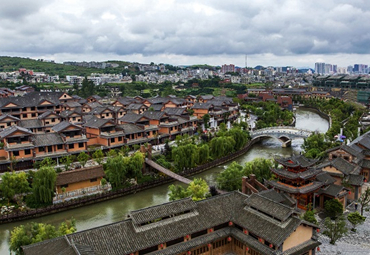
Besides hiking Fanjing Mountain and then soaking in hot springs, travelers to Tongren can also explore ancient architecture at the Zhongnanmen historical and cultural tourist area and discover the former mercury mine site in the ancient town of Zhusha, which means cinnabar.
 Overview
 Guiyang
 Guian New Area
 Liupanshui
 Anshun
 Qianxinan
 Qiandongnan
 Qiannan
 Zunyi
Zunyi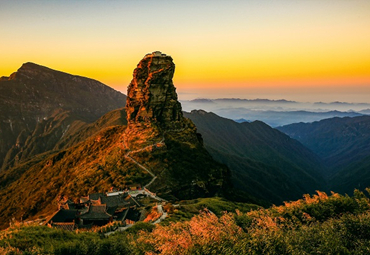 Tongren
 Bijie
Bijie Discover Cool Guiyang's new top 10 sights
 Guizhou's contribution to China's Development
 In Guizhou, bonfires and torches light up festival


All rights Reserved. 京ICP备13028878号-8